Sometimes, you are destined to find a book.
A couple of weeks ago I found myself looking for something to read before taking the train from Lyon to Paris.
I entered the kiosk in the train station and looked at the titles of the paperback books waiting for their readers in the corner of the store.
My attention was drawn to the name of a writer : The writer’s last name was De Lattre, the name of a very famous French general who refused to collaborate with the Germans during WW II.
When I looked at the cover page, I saw the title, “La Promesse, “which translates in English to “The Promise.”
I turned out the book was about the destiny of a Jewish family during WW II, so of course I bought it.
It turned out the book was beautiful, touching, painful and interesting.
When I finished the book, I did something I only rarely do.
I immediately read it again, because I realized that the first part of the book was more interesting to read once you knew the end of the story.
Book Summary of La Promesse by Marie de Lattre
The book was written by Marie de Lattre, who it turns out, has only her family name in common with the illustrious general.
Marie is the daughter of Jacques, an orphan, who lost his two Jewish parents at the age of 8 because they were murdered in Auschwitz.
Jacques, once an adult became a physician, married and had two children.
Like many children who survived the Shoah, he never really talked much about his parents and did not raise his children with Jewish traditions.
But as he knew that in Judaism children become adults at the age of 12, 13, he invited both his children for dinner at that age, and revealed to them that their grandparents were Jewish, and were murdered in Auschwitz during WW II.
He told them this was a secret and made them promise to never reveal his secret to anybody.
His children didn’t really know how to handle this information and the subject was never discussed anymore.
Jacques died of cancer a few years later.
After he died, his wife, Marie’s mother, revealed to Marie, that before they married, Jacques had another child, much older than Marie, a son.
This son grew up in the States and was never recognized by his father, Jacques.
Marie felt a great sadness after she learned about the existence of her half-brother who grew up without his father.
This sadness she realized, she had inherited from her father, her grandparents and a from a family that she never knew.
Marie then started an investigation that took her many years and that lead her to an incredible, sad love story between 4 people: her Jewish grandparents, Ismak and Frieda Kogan and two French non-Jews, Pierre de Lattre and Madeleine Livet.
Ismak Kogan, a Ukrainian Jew who immigrated to Paris in 1926, married his wife Frieda after they met in Paris.
Ismak was a painter, and Frieda, who was born in Lithuania, was a convinced socialist.
The couple bought a house outside Paris and opened an inn for foreign artists.
In 1934 their son, Jacques, was born.
Shortly after, Frieda and Ismak became friends with Pierre de Lattre, a French student. Pierre and Frieda fell in love with each other, while Pierre remained a loyal friend to Ismak.
When the Germans invaded France, the Kogans were forced by the French government to give up their hotel and sell it to “an Aryan”, a non-Jew.
Pierre de Lattre immediately proposed to buy the inn so they could continue to live and work there.
In 1942 Ismak met Madeline Livet, a practicing, catholic women who worked as a nanny.
They deeply fell in love with each other.
But in that same year Frieda and Ismak had to go into hiding because they were due to be arrested and deported.
Ismak and Frieda had no other choice than asking Pierre and Madeleine to help them.
Pierre and Madeleine met and started working together to help their lovers as much as they could.
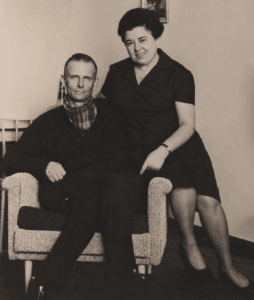
They organized a hiding place for them in Paris and a separate hide out for little Jacques.
Jacques was first brought to Pierre. Pierre managed to buy forged papers for the little boy that mentioned Jacques was his son.
Later Jacques left Paris with Madeleine and spent the rest of the war with her in the country side.
In that same year, Ismak and Frieda were betrayed and arrested.
They were imprisoned in Drancy, the French transition camp.
While they were in Drancy, Pierre and Madeleine sent them clothes, food and the four lovers wrote each other as much as they could.
Despite the help of Pierre and Madeleine and their attempts to avoid their deportation, Ismak and Frieda were sent to Auschwitz in the beginning of 1943.
Upon their arrival in Auschwitz, they were murdered.
After their deportation Madeleine traveled with Jacques to the center of France where they lived until the end of the war.
When the war was over little Jacques moved in with Pierre, who officially adopted him.
A few years later Madeleine joined them.
She and Pierre married and she became the adoptive mother of Jacques.
And eventually, they became the adoptive grandparents of Marie, who like her father, inherited the family name of Pierre, de Lattre.
My analysis of La Promesse by Marie de Lattre
So, this tragic story turned out to be a circle of love and passion between 4 people and a little boy.
Their love could not protect Ismak and Frieda, but Jacques was saved.
And later, Jacques raised a family and tried his best to be a good father.
After he died, his daughter Marie could not live with the idea of not knowing her roots, so she had to uncover the history of her family and wrote this book.
She decided to break the promise she made to her father. She investigated the Jewish history of her family and she united with her half- brother and broke with the silence that her father needed to live his life.
Breaking the promise was her way of picking up her life and giving roots to her own children.
My tours in Paris
When we visit the Shoah memorial during the Jewish tour, I like to show the names of Pierre and Madeleine de Lattre-Livet who were recognized in 2014 as Righteous among the Nations.
Their names are engraved in the wall outside the memorial, together with 4000 other names of French Righteous.
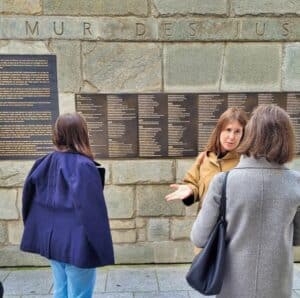
When entering the Memorial, I always show the white wall made from Jerusalem stone.
The names of the 76000 Jews that were deported from France are engraved in the stone.
The names of Ismak and Frieda Kogan on this wall are their tombstone.
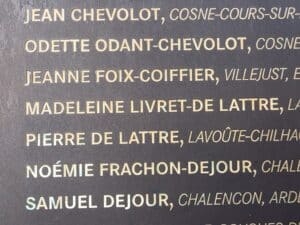
The Shoah Memorial has very symbolically put the names of their saviours, Pierre and Madeleine, on the wall outside the memorial that is surrounding and protecting the inner wall with the names of Ismak and Frieda.
As if they are still protecting them.
If one day this beautiful book is translated to English, I will be the first to let you know :
Email : Flora.goldenberg@gmail.com
Author : Flora Goldenberg
I am Flora Goldenberg, an art historian specializing in Jewish history, holding degrees in History and Art History from Sorbonne University.
As a state-licensed tour guide in Paris, trained by the Shoah Memorial of Le Marais, I lead immersive tours for adults and school groups through Le Marais and the Louvre, exploring both the historical roots and contemporary life of the Jewish community.
To bring depth and accuracy to every tour, I continuously read and study historical works, memoirs, and academic research on Jewish heritage, art history, and the Shoah—distilling these sources into clear, engaging narratives for my guests. This ongoing research allows me to summarize complex histories into accessible, meaningful stories, whether recounting a single family’s journey or the broader arc of a community’s resilience.
Coming from one of the few Ashkenazi families continuously present in Paris for over a century, I offer a deeply personal perspective. Thanks to my family heritage, I can provide access to private sites and synagogues, creating rare and meaningful experiences.
Date Article Published : 15th August 2026
Enforced Copyrights – Full Legal rights – OWNER – EU & USA – Flora Goldenebrg
You are not allowed to use this article or a part of it. Please contact : Flora.goldenberg@gmail.com for collabs.